Showing posts with label writing. Show all posts

Wednesday, March 6, 2019

Writer's Block: Could you have it? What to do . . .

"Even if your first novel is published by a Big 5 house and ends up on the NYT bestseller list, you can get a massive case of writer’s block. I know a wildly successful author who went through this."
Anne R. Allen

What is Writer's Block?


Like a mirage that can't be identified, the frustration of writer's block is an almost unfathomable force. Anyone can suffer from the affliction, any time, no matter their level of experience; but, only the experienced or informed have the better chance at successfully combating the invisible oppressor.
photo image of blank papers, a result of writer's block
Photo by Brandi Redd, Unsplash

We'll call it what it is, because it is possible for a sufferer to live through a block without realizing it.

There are hundred ways we tell ourselves "later", that don't seem all that serious.

It can take a serious bout of self-sabotaging procrastination, or worse, to realize a block has landed upon us with heavy ferocity. 

Think about it: that necessary book you've been putting off . . . or think about why you're not sending your short work to publishers (if you're not)—are you certain about your reasons for delay, or could there be a block upon you?

Merriam-Webster defines writer's block as "psychological inhibition preventing a writer from proceeding with a piece". Theoretically, a writer could have situational writer's block. At the other end, a writer could find themselves unable to write at all for a period of time.

As writers, we need to take seriously any signs of a lack of motivation. The seriousness of writer's block is, first, in being unaware. Then, when you become aware that you have this problem, you may experience stress and compromised output over a perceived inability to overcome it.

Awareness is key to identifying issues related to writers block and staying ahead of the curve, lest fall behind. So, let's look at how we can
beat writer's block!

Visit: How to Overcome Writer's Block

photo image of man in consternation under palms "during golden hour"
Photo by Andy Do on Unsplash

Friday, September 7, 2018

Writers Prompted to Write More via Medium Policy Requirement

Medium prompts regular activity from its writing members by establishing a quasi negative-reward policy designed to remind users of their best interests. The goal: getting users to stay active on the Medium platform, thereby increasing odds of activity.

According to Medium authors:

"Activity can include recommending, highlighting, or publishing. Accounts may be removed after 6 months of inactivity."
Any user of the Medium platform must remain active or risk losing their account. So if you're a Medium reader of the quality content to be found there, make it a point to check in regularly.

Man sits in coffeeshop scrolling phone, reading
Photo by rawpixel on Unsplash
If you're trying to imagine an easy-to-remember memory check, then do it quarterly. Add it to your quarterly calendar.

We know how it is . . . it can be incredibly difficult to eke out time for every entertainment in which we partake. However, it's important to remember that Medium is one site that offers a multitude of benefits. The cutting-edge writing platform is much more than a water cooler hangout. Within it's folds are rich salons where everyone's welcome to introduce and discuss mostly-important topics.

If you liken our Medium fix to a favorite magazine, then put it on our monthly, weekly, or daily calendar. See new material every day! It's as easy as setting, then clicking a Medium bookmark. Save it in your browsers now if you haven't already.

Again, whether writing or not, users who don't remain active could lose their accounts after six months of inactivity at the Medium website. To prevent this, all a user needs to do is log in, read a story, pick a favorite highlight and comment.

Directly related to the activity requirement is an interesting feature:

Per Medium,
"We don’t accept requests for inactive accounts, unless you own a registered trademark for it."
Writers, marketers, and other Medium users may want to consider applying a trademark to their usernames. It's too easy to get involved in a demanding project and unable to return to a personal one for some time, so this policy could be a significant risk.

We hope this will be a useful reminder to Medium users who are either unaware or have forgotten about this important requirement of their Medium account.


REF:

Medium authors. Medium Policy. Retrieved September 2018. https://medium.com/policy/medium-username-policy-7054a77fb04f

Jane Haskins, Esq. How to Trademark a Name. Legal Zoom. Retrieved September 2018. https://www.legalzoom.com/articles/how-to-trademark-a-name

New Tech Thriller Designed to Play on Daily Web Trepidations, Fear

A new technological thriller, in theaters this weekend of September 7-9, promises to shake our prevailing perceptions of mystery, technology and fright.

When his daughter, Margot, goes missing, David Kim (John Cho) embarks on an investigation of her online activity, where he finds a frighteningly different landscape than he expects.
"Searching" movie poster
Find "Searching" in Theaters

Along as voyeurs, audiences can expect an amplified version of the discomfort we experience when we find unexpected manifestations of the unknown and perceive some distinctive yet unidentifiable threat. This can happen to us anywhere, but in "Searching" we're taken deeper into the void of fear we experience when the unknown pops at us from our computer screens.

Also, for David, the waking nightmare involves one of the greatest tragedies: losing a child . . . more, losing them to the unknown. In realization of his new, personalized reality, Margot's father cannot avoid the dive into a new, unfamiliar dimension to find her.

Specifically, Searching was scripted and designed to play on that version of ourselves that deals with technology on a fairly consistent basis, and turns this world upside down. The toppled dynamic of this dark-web whodunit began as early as drafting the script, where the writers presented a "scriptment" to better illustrate the production requirements of theme and event translation to the final product, the movie . . . as reported by Mekado Murphy via the New York Times.

Considering that most everyone can appreciate the need for a bigger screen when working and playing online, we suggest that audiences enjoy the intellectual dark-web thriller in theaters before it's gone.

. . .

Read more about Searching at IMDB.

Wednesday, August 8, 2018

Ebook Review: The 5 P Approach to Copy that Crushes It

The 5 P Approach to Copy that Crushes It This 43-page ebook by Copyblogger introduces a set of core concepts behind their copywriting methodology and absolutely "crushed it" for me.

I've written copy for several years (a few, if we want to pare things down to actual working time) and found "The 5 P Approach" to be a real stroke of luck in the confirmation domain of my psyche. Recently, I'd changed approach in some of my 'pretargeting' efforts in a way that involves more exposure risk than I'd been willing to take before, or believed would be smart.

Unfortunately, fear of alienating half a population can freeze you into some tight spaces, and I appreciate being redirected . . . back again to a more familiar mindset. I'd been veering off track in a way that wasn't necessary.

Like an unexpected, karmic answer, Copyblogger confirmed my decision when I hadn't realized I was looking for that support . . . which in turn confirms that I have a lot of work to do yet in realizing some of my best goals.

The 5 P Approach: Something for Everyone


An experienced or schooled marketer will find the comforting familiarity of industry-speak and fresh tips while, perhaps, also a refreshed point of view.

All readers will enjoy the digestible, entertaining case studies presented. After all, who doesn't love the best and most memorable ads! For many of us, half the fun of Superbowl is in watching the first-aired, fun advertisements.

Anyone new to the world of marketing, or sales, absolutely can consider this book a reasonable investment of the short time it takes to receive the message.

Tuesday, August 7, 2018

Writing Prompt - 3 Ways to Save the World: What Would You Do?

Imagine that you've received a call for a meeting, in which it's expected that you will offer three serious suggestions intended to improve the world.

PD Image via Lisa Fotios at Pexels, person journaling with comforting drink in cup that says "Be Happy"
PD Image via Lisa Fotios at Pexels

One of your suggestions would be chosen, and you have no option for an order of importance pick—the influencer(s) who invited you make the final decisions. You may offer reasoning that could influence their pick!

When you're done with your writing, post it, and feel free to link it in comments.

Tuesday, February 6, 2018

In Mind of the Progressive 80s Workplace, A Call to Community Through Work

It wasn't that long ago that an emphasis on collaboration and accommodation were used in workplaces intent on production enhancement, conflict resolution and-- ultimately-- longevity of cause. Similar standards of behavior may still apply in our greatest endeavoring toward true community rooted in sustainable livelihood. Today, however, we want to shed a little light on what's taken place overall during the last 20-30 years in the workplace and in politics.

The 80s Workplace


Some of us will remember (and may still benefit from) those mysterious suggestion boxes, the oft' faulty questionnaires, employee essays, and other progressive managerial tactics that better ensured all voices were heard and considered. This kind of best-practice human resource model exhibited general positives for those at all levels of an organization.

We've taken an alternate turn, though. We haven't continued in that vein of commitment to our business in life. We haven't shown loyalty to the importance of local and progressive community livelihood, which begins in the opportunities community members have beyond their personal lives, on both individual and community planes of existence. Instead, we've let the profits of a few get in the way of the pursuit of livelihood for the many.

If we look, we see this happen early with regard to Wall Street. As early as the turn of the nineteenth century, New York stock (and slave) exchanges pushed residents away from their homes in search of quieter neighborhoods uptown. The business of money outranked the people from the beginning! Yet, it was still nearly impossible to see in the 1980s, when the worst of modern Wall Street hadn't yet hit its marks so hard. During this time, most people understood mostly the benefits of investment schemes if they thought much on it at all. After all, Wall Street had its history of scrapes and falls, but as the primary entity of trade, it wouldn't be negatively affected with any kind of permanence. Rather, its affectation extends well beyond its few blocks of the world. 

It's 1999-- almost everyone in responsibility to their outcome is afraid now


By this time, the bite of Wall Street had become more evident than its bark. Certain generations have come to realize that they're being knocked back in more ways than one. More people fear their financial future, and have become saddened under evidence that warring over international interests won't end any sooner than the drain of Wall Street on Main Street. The Persian Gulf war(s) hadn't seemed like a never-ending issue in the early 90s, but still a minor depression seemed evident in U.S. society over this recently-developed situation. We posit that this is powerful fuel to hoarding mindsets.

It's a top-down effect. Even the Wolves are openly afraid of and for their jobs now. They realize it could be the life or death of them financially, and possibly literally. Our real problem now is that our attention still isn't ON Wall Street as a bastion of demise to integrity-- of a person, company, or on any national front. We're occupied instead with concern over Y2K, millennial apocalypse, and other things less real than what was actually taking place.

2010s Information Age Begins Relent to the Unknown 


It's been interesting to watch community ideals in the workplace fall by the wayside in many cases, especially after the economic crash and Great Recession of 2007-2012. Since then, it's been apparent that the competition-in-conflict paradigm has been useful to the quick-gain and release methods of investor-model business. The effect is similar to that of our most life-threatening situations. Psyches remain at attention and in potential conflict at all times. Under this kind of unhealthy management practice, either weak or strong stakeholders are pushed out doors and businesses remain in a constant state of unsettled battle . . . much like those people on the floor of the stock exchange.

Top-Down Issues in Politics


Consider, for example, the sharp divisions sowed recently into our most important cause of unification and success for all-- politics. We have a situation in politics, once again, where the people are goaded into battles of each other's ideals. In this age, it's a constant barrage and often takes form in the workplaces of the people. It's gotten so that certain members of every side desire [vocally!] to break the system . . . in which case no course correction can be implemented, much less leadership grounded in ethics (a progressive ideal). Who does this competition benefit? Think about that.

Considering that the current national leadership is rooted in the ways of a socially preordained and funded 'business personality' before all else, we'll look at it under a business scope. Under the managerial practice of competition conflict solutions, benefits are gained for one person or tribe only. This has its uses, but is over-relied upon in everyday business and wholly inappropriate for the public or national interest. Everyone knows what happens to the tribe(s) that don't 'win' that singular prize moment. And as for the winning tribe, there is no actual win. There will be no long-term revenue. It's a temporary salve for a temporary issue in a temporary space.

Overall, even in business, competition conflict resolution is the wrong way to go. Our best interests lie in the integrity of community, even in the workplace (where life begins for roughly 98% of the people). If community integrity can't be found there, then it'll be insufficient everywhere else.

Wednesday, January 10, 2018

Writing Contest Opportunity for West Virginians

According to The Morgan Messenger, residents of West Virginia have the annual opportunity to submit their writing to a round of contests hosted by West Virginia Writers, Inc. (paid for via entry fees). Deadline for entries is March 30. Out-of-state hopefuls apparently can participate in the fun by joining the club.

Sunday, January 7, 2018

Is your story's charcater proud, or prideful?

Some say pride is a sin, while others don't believe in the concept of sinful offense. Either way, the word has two distinct connotations when we consider either its secular or religious nature of use.

text image reads: Pride & Hubris are not the same

Hubris is, simply put, excessive pride . . . which can be difficult to curb! After all, humans are compelled to our own self-help notions on a fairly regular basis in efforts to keep our heads above solemn waters. We learn to take pride in ourselves and our accomplishments, as a means of recognition of our best efforts. Easily, we can become prideful.

As well, we can naturally feel a sense of pride, or fulfillment, through the things we do or have. We can—and do—exhibit that which makes us proud. Because pride is an emotion rooted in our ownership of a thing, or of a moment in time, it's wise to mind its foundation in certain moments. We should avoid being prideful, or showing hubris, except in those rare moments where we might be allowed (expected, even) to show some all-out glee.

In the same way that we want to represent ourselves in our best light, we want to ensure, in writing or telling stories, that we develop our characters in such a way that they're represented accurately throughout . . . whether negatively or favorably.

***


Thursday, November 30, 2017

Happy Birthday Mark Twain, born 1835 November 30

A favorite author to many, Mark Twain lived from 1835-1910.

Born and raised in Missouri when slavery was practiced openly both domestically and as a means of production in parts of the United States, much of his well-known written work reflects the cadence of Missourian lifestyles during that time. Some of that work has long been challenged, censored and banned under certain circumstances due to its politically challenging nature and offense to the sense of modern humanity. Racial content reflected in Twain's "Adventures of Huckleberry Finn" for example, has been determined by some as too uncomfortable to be appropriate for students.
Black & white image of young Samuel Clemens

Twain freely traveled often, and made his possible contributions to the world around him. Formal education had been cut short for him after his father's death at Twain's age eleven, when those around him still knew him as Samuel Clemens. Young Samuel gained employment instead, but was able to remain close to his talents and interests through work. He gained further education via public libraries in his spare time. Knowledge gained as well from a lifetime of travel (during a time of slow news and locally-curbed information) lent a great deal of perspective to his own unique brand of storytelling.

The particular experiences met by Samuel Clemens in a developing world ultimately led to his legendary status as a U.S. native, writer and author of valuable, telling, and impressionable works-- writings that collectively cast a reflective eye on human conduct in that world. Notably, Mark Twain's writing continues to echo memories of a younger nation, unified-yet-separate, as its inhabitants lived and toiled.

Friday, October 20, 2017

Why I Write: October 20 Annual Writing Hashtag Event

The National Day on Writing inspires a time during end-October for writers and associates to celebrate and organize events. Centered around a concept of the National Council of Teachers of English, the day honors the constant relevance the written word. (Since 1911, the NCTE has organized for the betterment of language art studies through various means). 

Developed by educators, the National Day on Writing appeals to teachers especially, who use the opportunity to enhance our perceptions of writing as a critical component of comprehension, learning, communication and overall understanding. For writers from any scene, October 20 each year is the date around which we can plan an event or outing according to this general theme.

We consider it highly appropriate that this writing event is coordinated with the cooling autumn weather, which happens to render steaming cups of coffee, tea and cocoa all the more relevant to our efforts. We're greater plussed if sweaters are needed.

Because the annual writing event happens to fall on a Friday this year, there's little excuse to avoid an appropriate event or activity this weekend. What will you do?

We should all get a start by answering the associated hashtag #WhyIWrite, via Twitter and other social networks.

Tuesday, January 31, 2017

Learning to Write, and Beyond- Consider Audience and Write with Purpose

Successful writers have learned, the old adage is true: good style is in the eye of the beholder. Writers do well to always remember their audience, which can vary. Our audience may be as broad as an open sea, or like the narrowest stream of water. 

Students and committed writers should take instruction and feedback with a grain of salt. 


Is your audience, in fact, a teacher? Then write for that audience . . . provide them what they need and you'll pass your course. This has nothing to do with the style you want to exhibit in your own writing, and learning to follow set guidelines will help you later with your personal endeavors.

The appeal of our writing to any other audience may not be as straightforward as in a classroom scenario. Under many circumstances, there will be no direction given for a writing assignment. Capacity to deliver appropriately will be assumed!

The biggest factor that works toward a successful writing project is in minding the congregation of any meeting or audience. Big or small, private or public . . . consider the qualities of the audience. Determine whether they're professional, laypersons, hobbyists, community. Also, why are you writing? Do you need to appeal to a particular crowd in order to get them to do something? Are you entertaining for for a few laughs, or do you need follow-through after the event?

Maybe you're writing for yourself, from a position of interest in organic attraction to your message. Whatever the answer, when you figure all the factors, your method becomes more clear. Above all, it's important to remember: never be discouraged from a craft you care about because of a critic or detractor along the way. Something can be learned from almost any critic, if only about them. It's quite possible that you were never writing for them! Your teacher, though . . . you're definitely writing for that critic. Do what you need to do in order to get that grade, and you might just learn something that you'll appreciate later. 
Image of a group of 7 gathered for a presentation being given by a figure with a whiteboard
A small group presentation

When you think about it, you may be surprised at the potential critics of a project. Don't let it overwhelm you. Just do the work and be prepared for anything.

During February, we'll take a look at some solid examples of author styles that have been heavily criticized, yet have also been wildly successful in finding audience.

Meanwhile . . . who are you writing for this week?

Monday, October 31, 2016

Monday Evening: Time to self-reflect and remotivate your entire work week

Image of a journal and pen
Let's face it: Mondays have potential to reset our tone for the week! Our busiest days are typically this first business day.

Consequently, Monday evenings can be the most difficult times we may have in separating ourselves from the day and achieving a more relaxed night. To resolve this issue, establish Monday evening as a priority time for a personal writing exercise.

Hint: undertake this exercise as early as feasible after your work on Monday

What kind of personal writing exercise can you do? Poetry is an option, and surely it can be effective to one's progress in the craft to set a standard time to practice those poetry skills. Other types of personal writing might include journal-keeping or personal essay pages.

The latter two are similar types of basic writing that offer a different starting mindset, and usually a different result. These types of writing can appeal to almost anyone, and it only takes one quick page to serve our purpose of changing gears for significant release of the day's tension.

Benefits of Personal Writing on Monday Evening


Consider that writing a journal entry actually records one or more events of your day, and may present you with workable solutions to a problem or event. Also, it's a way of logging milestones at a regular interval. Because Monday happens to be an easy day to remember to write a journal-- aka diary-- entry, we've expanded our original thought to include this basic task as a means of reflection and release. This is one task with great potential of personal reward.

To write a journal entry any day(s) of the week has long been a way for professional or hobby writers, as well as any person from any walk of life, to log progress and failure, dissect thoughts and imprints, and generally sort themselves out mentally.   

Alternatively, a personal essay is an opportunity to expand this personal writing exercise beyond the borders of a typical journal entry. You may have a great idea or topic ready to go. Or, maybe you've been too busy to consider it. No worries! Whatever you've been working on throughout your day, you can create a mental release (and still achieve some productivity) through a writing prompt. Such a prompt can be sourced almost anywhere:

  • any major or minor event of the day that stirs some emotion
  • local news items or politics
  • an intriguing billboard statement, image or other stimulating input you've noticed on the way home
  • a picture in a magazine
  • an article you've read
  • research #writingprompt

Simply, pick a prompt and begin to write!

Any writing exercise we've highlighted here may be the key you need to unlock a restful state of mind. Adopt the habit. It's potential is regeneration for a fresh Tuesday and greater chance of a positive week.

Review:

Monday journal - make a diary habit on Monday, soon after work. It's an effective way to recall and evaluate the effect of your preparations for that Monday; further, to consider the day's unfolding and whether anything could have been better executed for a smoother start the next week. Essentially, it's a great way to confirm that you've set your week up in the most productive and efficient way possible.

Monday essay - relative to a journal entry, the personal essay offers a means to break a day's litany of events by using a writing prompt to generate new thoughts (and new written topic material). You could relate the prompt to your day, or choose a wildcard prompt. Either way, expect a mental boost! Through the effort of a personal essay, we're pushing our minds to work in different directions, in effect reaching out from at least one different perspective.

Whichever way you go, it's only going to take a time or two to realize some the stated benefits. Let us know if this is similar to something you already do, if you plan to add this Monday task into your routine, or when you have results! Feel free to link an entry you've published in comments.

REF

Notepad image via crisg at Openclipart

Thursday, August 18, 2016

Does Horror Entertainment Have Value?

Image shows Kevin Bacon getting throat cut in Friday the 13th scene
Kevin Bacon in Friday the 13th

Horror is a complex literature genre. I once believed horror to be the lowest of things that should interest a person, often resisting the most popular horror flicks of the 70s and 80s as I slumbered with friends during our weekend overnights. But does horror entertainment offer any redeeming value?

Friday the 13th is a terrific example of such an horrific production as was usually declined by me. While friends picked the quickly popular and serialized Friday the 13th releases, along with titles like Halloween or Silent Night, Deadly Night (give me a break!) I'd be the one that picked up a comedy . . . something like Airplane! or Private Benjamin -- a way to break up the monotony of fearsome scenes sure to curdle our senses.

You might be thinking that Friday the 13th isn't a great example of lit horror, because it was a movie. Well, people loved that slasher movie so much that a huge franchise was developed which included novels. The first Friday the 13th novel hit shelves only two years after the original movie of 1980. The second movie was released less than a year after the first and the third movie was also quickly released-- in 1982-- after which, the first novel adaptation (of part III) appeared.

Eventually, I learned that fear and fright are parts of life that present in a variety of ways, sometimes via cloaking and surprise while other times apparent as the fallen night against it's prior day. I understood that, while a particular type of horror did not appeal to me, there were other stories of atrocious nature that did. Enter Stephen King (SK) into my life, by way of written word and the junior high school library. But first . . .
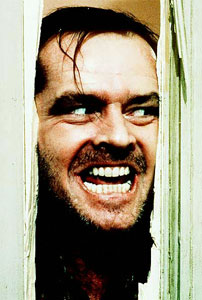
Image of Jack Nicholson as Jack Torrance in The Shining
Jack Nicholson in The Shining

I was a "young adult" upon my first reading of a King novel, The Shining. My mom had allowed me to bring it home from the fiction section of the city library. Myself in the budding portion of young 'adulthood', about age 10, this particular title was a bit much . . . but an honest try was given to the big read.

It's difficult to remember what I would have reverted back to at that time (too old for Nancy Drew, too young for Jack Torrance), but believe that it wasn't long before I recognized the author's name on a library shelf at school and picked up the much smaller Cycle of the Werewolf (a novella). Funny, because I'm also not much of a werewolf enthusiast . . . but it was a gripping, digestible story with which I could identify in more ways than one. Suddenly, I was hooked on horror fiction.

What made me pick up The Cycle of the Werewolf? The back-cover synopsis, of course. Check it out (click on it to find your own copy):

https://www.amazon.com/gp/product/0451822196/ref=as_li_qf_sp_asin_il_tl?ie=UTF8&tag=thewrirou-20&camp=1789&creative=9325&linkCode=as2&creativeASIN=0451822196&linkId=0e598080d68fca9f622246abb8e900f6


So, it was through SK that I learned the horror genre contained works that didn't need to objectify young women by stripping them to murder them, and also managed to touch on common, heavy emotions and themes of everyday living while exploring ancient themes simultaneously. Over time, horror themes proved to continue showcasing the aforementioned scenarios . . . and more.

Life can be horrific. Art reflects that fact as well as it does the beauty of existence. As such, horror can have positive value, and often does. It's comparable to any fiction or drama that entails a happy ending. Horror's not necessarily much more than conflict, with either a good or bad turnout.

Why is horror-genre entertainment so controversial?


We hold "redeeming value" so dear. Is it possible that sometimes we simply lack sight of it by way of our own short vision? Maybe, when we fail to see any redeeming value of an entire genre, it has less to do with genre and more to do with style. It seems to me that, when a story is riddled with elements of instant gratification, any redeeming values run the risk of being hidden in shadows of whatever is excessive, be it sex, nudity, violence or opprobrious language.

You'll hardly catch SK using excessive gratification to sell his essentially mainstream novels. Yet, a certain number of people might accuse his work of having no redeeming value. (Yes, they're few and far between these days, but they exist.) I'm positing it's because they only know the work as 'horror' genre and associate it with a particular style, which it's not. It's value is assumed by association.

Horror's "Redeeming Value" Background


I've used this particular and popular author as an example because he's been my experience in touting the allure of horror for as long as I can remember. Heavy reference to young adult reading in this post is due to the "redeeming value" link in paragraph nine, above, which called to  mind my own work that on occasion has been focused in the YA sub-genres of literature-- specifically in the genre of horror-- and because most of us get our first introductions to horror genres as adolescents.

Perhaps we'll look further into redeeming-value horror stories as time passes. Can you think of a horror story that left you with a positive feeling or lesson?